
Handmade Policy v. 7 (effective 11/20/25)
The purpose of this handmade policy1 is to outline:
- Guidelines for who gets to list what kind of products on our marketplace
- A verification system
- An enforcement and resolution process
- Glossary for all important words and phrases in bold italics
Handmade Guidelines
The definition of “handmade” has vexed artists and thinkers for hundreds of years, and we do not present a grand solution to an impossible problem. We intend merely to shape what kinds of products are on our marketplace.
In this section we have created a technical definition as well as some specific examples of what our marketplace does and does not allow when those artisans might be on the boundaries of the definition.
This definition attempts a technical definition of a cultural concept. It is imperfect. There are naturally ranges, scales and shades of workmanship, which will be interpreted, verified, communicated, and enforced according to the processes discussed in the next sections.
Definition
- The definition of an artisan for the purposes of our marketplace is a person, micro-business, or collective that produces handmade goods for sale.
- Handmade goods are authentic original works produced with the care, dexterity / skill, and judgment of the artisan, under the workmanship of risk.
- The workmanship of risk is an original idea proposed by artisan David Pye. In essence, it means that at some point in the process, the artisan could ruin the work.2
- Although artisans may in their judgment sometimes require production assistance (outsourcing) to the extent allowed by this policy, we will actively encourage, promote, and support artisans who produce their products using in-house production. Print-on-Demand is a type of outsourcing only allowed under certain circumstances.
- On these particular topics, we are providing additional clarification on what our marketplace specifically includes and excludes. Our marketplace specifically includes:
- One-of-a-kind works that by their nature need to be sold in faithful reproductions:
- Print material manufacturing is allowed outright in the care and judgment of the artisan: whether they print in-house, choose a Print-on-Demand production method, or purchase the reproductions up-front from an artisan’s favored printing house.
- Custom manufactured goods (such as enamel pins, custom playing cards, plushies, etc.) are allowed with in-house production or artisan’s favored manufacturing house, but not Print-on-Demand.
- Digital works: Original creations made with computers, tablets, cameras, etc. can be sold as digital downloadable products.
- Food, plants, and non-alcoholic beverages, subject to government regulations, per the Terms of Service. Artisans are ultimately responsible for the safety and compliance of their products.
- Significant and original in-house modifications to mass-produced, recycled, or vintage goods through the workmanship of risk, such as through sewing, screenprinting, heat-pressing, embroidering, etc.
- Handmade goods with mature / NSFW (Not Safe for Work) content, in accordance with our Mature Content / NSFW Policy.
- One-of-a-kind works that by their nature need to be sold in faithful reproductions:
- Artisans Cooperative reserves the right to remove listings of products that do not comply or that may be unsafe for any reason. Our marketplace specifically excludes:
- Mass-produced goods (common swag, wine glasses, coffee mugs, blankets, mouse pads etc), except those addressed elsewhere in this policy, produced by the workmanship of certainty even if they have original artworks by authentic artisans applied to them.
- Un-original works, most particularly those that rely heavily on works in the public domain or artificial intelligence (AI) or that infringe on another artisan’s original works.
- Re-sellers and entrepreneurs whose business is to sell others’ products, whether curated vintage goods, licensed artwork, or even authentic original artworks commissioned from an authentic artisan with a commercial license. If “somebody” handmade it, that’s not good enough. (As one artisan put it: “We are the Artisans Cooperative, not the People-Who-Take-Advantage-of-Artisans Cooperative.”)
- Prohibited items, particularly those that promote, support or glorify hatred or violence, or are unlawful, per the Terms of Service. These include such items as alcohol, tobacco, drugs, medical drugs and devices or items that make medical claims, weapons and dangerous items, items with intellectual property violations, hate and violent items, and illegal and highly-regulated items.
- Contracts and services: intangible skills and activities that do not result in a returnable and deliverable physical or digital product.
Handmade Verification
- To sign up to the Artisans Cooperative website, artisans must attest that their work meets the handmade policy. This will be done by signing an agreement to the Terms of Service during the sign-up process.
- Prior to signing up, if the artisans have any questions about the handmade policy and how it applies to their work, they can contact the co-op to discuss their situation.
- All artisans will be labeled either Verified or Unverified. This label will not be different for member-owner artisans or non-member artisans (there are separate labels, perks, and incentives for member-owners, as outlined in Membership).
- Verification will not be a requirement to list on the marketplace, but it will have perks and artisans should be incentivized to volunteer for verification:
- The label will correspond to site search filters for customers looking for authenticity.
- Special privileges in marketing, such as blog features and social posts.
- Special privileges during any Enforcement Reviews (more on that in the Enforcement section).
- Immediately upon signing up, all artisans will be “Unverified.”
- Artisans can become “Verified” by either voluntarily submitting their shops to the verification process, or via an Enforcement Review, as described in the next section.
- There are two ways to become Verified:
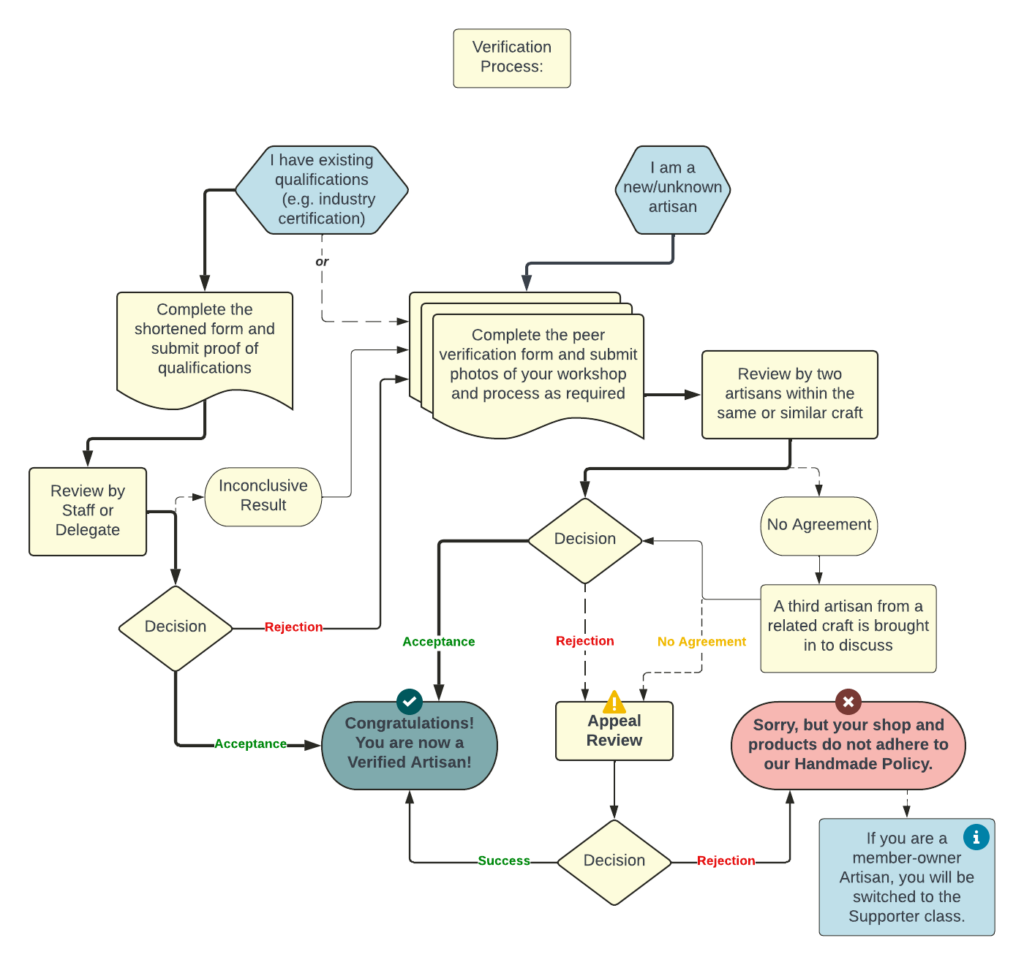
- Peer Verification: All artisans can choose to become “Verified” by submitting to a verification process held by their peers, who must be member-owners.
- The Peer Verification process is mandated for Enforcement Reviews.
- Peer Reviewers will be selected from a database of fellow Artisans who are willing to serve in a peer verification capacity. In the database, Artisans will specify their areas of expertise, and to the greatest extent possible, will be matched by craft. For example, a jewelry-maker undergoing verification should ideally be reviewed by fellow jewelry-makers.
- Peer Reviewers will have to undergo training on this Handmade Policy, confidentiality, and the co-op’s mission prior to reviewing. The purpose of the review is to enable and amplify authentic Artisans on the marketplace and flag any Artisans that don’t meet the Handmade Policy.
- The application for Peer Review will be kept strictly confidential to the Peer Reviewers, the artisan, and co-op management. The application form will include, at a minimum, a series of photos, that must include within the photo a sheet of paper with a specified identifying date and title. These photos would be required, at a minimum:
- the workspace or workshop (or equivalent),
- material storage (or equivalent), and
- major stages of production of a work that best represents the artisan’s craft and intended product listings.
- The hours spent by Peer Reviewers in voluntarily verifying peers will accrue points in the points-and-tiers system for member-owners, earning the Artisan additional benefits.
- Two Peer Reviewers will be selected for each Peer Verification.
- Peer Reviewers will complete a standard evaluation form that includes a statement of reasoning for their decision, which will be shared with the Artisan. The results of the review will be one of three outcomes:
- Verified
- Modifications Needed
- Non-Compliant
- The two reviews will be blind (Peer Reviewers may not discuss). If the two Peer Reviewers agree on the outcome, the decision is made.
- Modifications Needed is, for example, when an Artisan generally meets the Handmade Policy but some of their products do not. In that case, the Peer Reviewers must explain in their evaluation why the products do not meet the policy for educational purposes, and require the Artisan remove the non-compliant items from their store within a specified amount of time in order to become Verified. If the Artisan chooses not to comply by the end of the time period, they will become Non-Compliant.
- Non-Compliant Artisans will be removed from the marketplace. If that Artisan was also a member-owner, their membership will be transferred from the Artisan member class to the Supporter member class.
- If the Artisan disagrees with the outcome, they can request an Appeal Review.
- If the two Peer Reviewers disagree, then a third Peer Reviewer will be selected, who may be of a different craft expertise. The three Peer Reviewers will hold a discussion, whether virtual or via correspondence. If an agreement cannot be reached, the three Peer Reviewers can recommend an Appeal Review.
- Appeal Reviews will be conducted by the Board of Directors or their chosen delegate, such as a Handmade Committee. The decision of the Appeal Review is final.
- Established Artisans: Artisans with a demonstrated track record and / or industry certifications can complete a shortened form, which will allow them to make the case they are already qualified.
- Shortened forms will be reviewed by a staff member or other person delegated by the Board of Directors.
- If the reviewer is uncertain, they can recommend a Peer Verification process instead.
- If the Established Artisan review results in a rejection, the Artisan can opt for a Peer Verification as a next step.
- Peer Verification: All artisans can choose to become “Verified” by submitting to a verification process held by their peers, who must be member-owners.
- If the verification review results in the Artisan being Non-Compliant, they will be removed from the marketplace. If that Artisan was also a member-owner, they will also be transferred from the Artisan member class to the Supporter member class.
Handmade Enforcement
- As a co-op, we rely on people power and the wisdom of the crowd to help us enforce this Handmade Policy with a “three strikes” reporting system.
- To begin, we will communicate this Handmade Policy regularly, widely, and transparently on our marketplace and all communications channels.
- To alert the co-op to Artisans on our marketplace who may not meet the Handmade Policy, we will provide a reporting form on our marketplace. We will make this form easy-to-find and accessible in multiple formats / media.
- The purpose of the reporting form is to flag artisans or products that the reporter thinks does not meet the Handmade Policy. This reporting process can flag any Artisan shop, whether member-owner or non-member, Verified or Unverified.
- Any single reporting form received on a product will trigger a review of that product by the handmade committee.
- Reports of multiple products may trigger a review of the storefront inventory by the handmade committee. If multiple products are found to be in violation of the policy the store may be temporarily suspended until in compliance.
- Three (3) reports by three separate reporters on one Artisan’s shop will initiate an Enforcement Review:
- If the Artisan is Unverified, their shop will be suspended during the review.
- If the Artisan is Verified, their shop will remain open during the review.
- The Enforcement Review will consist of a Peer Review Verification process as described above. The following are unique to the Enforcement Review:
- If the result is Verification and the Artisan was Unverified, the Artisan’s shop will be immediately un-suspended and they will receive a Verified label.
- If the result is Verification and the Artisan was already Verified, the Artisan will be re-rewarded points for verification if they are a member-owner.
- An Enforcement Review will not be conducted on a Verified Artisan shop more often than once a year, unless the Artisan’s product listings have significantly changed.
- To prevent the enforcement process from becoming abused, we will take the following additional steps:
- The reporting process will not be anonymous: reporters must provide an email address or basic contact information.
- Results of reports will be tracked with the reporting info in the same database and reviewed periodically, not less than once per year.
- Examples of data signs that would trigger an action:
- A particular reporter has a high number of reports and a disproportionately high report rejection rate (ie, if the reports keep kicking off a review process that results in a Verified Artisan).
- A particular Artisan shop is found to be targeted at a disproportionately high rate.
- If the data shows any signs of abuse then special measures may have to be taken, such as exempting an Artisan’s shop from the Enforcement Process to protect them from bullying or harassment, or removing an abuser from the marketplace and/or co-op.
Glossary
Artisan
A person, micro-business, or collective who produces authentic original works with care, dexterity / skill, and judgment, as the workmanship of risk.
Collective
A formally incorporated cooperative of artisans that is majority-owned by its members, or an informally organized mutual aid society of artisans that is represented by one designated person.
Custom manufactured goods
Goods produced via outsourcing in batches to an artisan’s specification, not single, like Print-on-Demand. Custom goods manufacturing often requires a set-up fee and / or sample and ensures the artisan’s care and judgment is reflected in the quality of the work.
Handmade goods
Authentic original works produced with the care, dexterity / skill, and judgment of the artisan, as the workmanship of risk.
In-house production
An activity that is conducted within the same business. Its opposite is outsourcing.
Micro-business
A micro-business is a type of small enterprise that typically has fewer than ten employees and limited capital investment.
Outsourcing
Outsourcing is the business practice of hiring a party outside a company to perform services or create goods. Its opposite is in-house production.
Print materials
Primarily two-dimensional paper-based materials that reach intended audiences through written words or illustrations, such as zines, stickers, greeting cards, posters, books, fabric, and canvases.
Print-on-demand
A special type of outsourcing that removes the artisan’s risk of being unable to sell the products that were created. “Print-on-Demand” (POD) is a printing technology and business process in which mass-produced “blank” products are printed with custom images and text “on demand” when the POD printer receives an order, allowing prints of single or small quantities. The printer provides mocked-up stock imagery for the artisan to post for sale on their selling channels. The order is printed and shipped directly to the customer. The artisan does not have to purchase inventory and does not touch it or inspect it. POD can be applied to a growing list of products, including print materials, basic apparel such as t-shirts and hats, and other mass-produced items like tumblers, bean bag covers, mouse pads, and plastic phone cases. Printful is an example of a POD service.
Workmanship of risk
“Workmanship using any kind of technique or apparatus, in which the quality of the result is not predetermined, but depends on the judgment, dexterity, and care which the maker exercises as he works. The essential idea is that the quality of the result is continually at risk during the process of making.” This original concept is explored at length in the book The Nature and Art of Workmanship by David Pye.3
Workmanship of certainty
“Quantity production, and found in its pure state in full automation. In workmanship of this sort the quality of the result is exactly predetermined before a single salable thing is made. In less developed forms of it the result of each operation done during production is predetermined. [Yet] the tools, patterns, prototypes, and jigs which enabled [the workmanship of certainty] had to be made by the workmanship of risk.” This original concept is explored at length in the book The Nature and Art of Workmanship by David Pye.4