
What is a cooperative?
Artisans is an online cooperative business, providing a better handmade marketplace for the community and the benefit of it’s members. Simply put, a cooperative (co-op) is a business that is owned and managed by its member-owners as a “one-member / one-vote” democracy. All co-ops are operated by a common set of values that put people over profits. In contrast to traditional companies, there can be no concentration of ownership among a few. All members equitably share the annual profits.
Historically, cooperative enterprises were common in traditional economic systems and cultural norms around the world beyond the confines of modern commercialism. Creative production was organized around community groups gathering to divide labor and increase output of everyday tools and products most households needed. Goods were sold in markets and along trade routes to other communities whose goods featured different skill sets, stylistics traditions and raw materials. Community members pooled commitments of time, materials, labor and funding to maintain a common baseline of livelihood. Tontines and esusu (African terms for rotating savings and credit associations) as well as burial societies and mutual working-sharing schemes for large, labour intensive ventures are among some of the examples of traditional voluntary and ethnic associations that provided services for the collective interests in pre-colonial Africa.
Many of these mutual assistance associations have persisted (particularly in rural areas) and evolved with time but still managed to retain their essential features and values. The combination of circular economies amongst households, shared production in communities and the trading of handmade goods lays the foundation for modern cooperatives.
The modern understanding of cooperative business model evolved during the Industrial Revolution. It’s happened over and over again throughout history, since at least the 18th century: the Industry starts squeezing and mistreating its workers. The workers protest to change their lot, and when their protests fall on deaf ears, they build their own businesses as an alternative to employment with the Industry. The earliest recorded cooperatives started in the late 1700’s, around the same time America was born. At first, the cooperative business model was experimental, and failures were more frequent.
Then in 1844, a group of artisan weavers in England established the first modern cooperative business model. The “Rochedale Pioneers” created a cooperative store for its members who wanted to buy “honest food at honest prices.” All members shared the profits at the end of the year, receiving patronage refunds.
Today there are at least 1.2 billion cooperative members of over 3 million active cooperatives on the planet. These numbers are tracked by the International Cooperative Alliance.
In America, cooperatives are ubiquitous but often go unrecognized. According to a study by the University of Wisconsin’s Center for Cooperatives, there are over 40,000 cooperatives in the US at more than 8,800 locations.
Cooperatives in the US include thousands of small local businesses as well as successful household names you’ve heard of. Major retail cooperatives include ACE Hardware, Land O’Lakes, REI, King Arthur Baking, Bob’s Red Mill, and Tillamook Cheese. They also include rural Grange halls, urban natural foods stores started in the 1960’s and 1970’s, credit unions, and electric co-ops. Electric co-ops together power over 56% of the nation’s landmass in 92% of persistent poverty counties.
There is now a name to the rising interest in online cooperatives: platform cooperativism. Certainly existing cooperatives of all kinds have run websites and webstores for ages, such as REI.com, but platform cooperatives is the name used for intentional online-only co-ops. The ideas behind platform cooperativism represent a return to the original promise of flexibility, autonomy, and independent livelihoods for online workers.
What do cooperatives value?
Cooperatives are a proven business model run by equitable and inclusive values. In the words of John Curl, “Worker cooperatives offer a way for people to get out of the boss system entirely, and to reorganize their lives on a different basis. They proffer group self-employment to people without the resources to start a business alone.”
The cooperative model is relatively simple. Yet if there were more cooperatives in the world, the impacts would be profound. The United Nations (UN) announced 2012 as the Year of the Co-op for an important reason: cooperatives are uniquely beneficial to individuals and society.
Pioneers wrote the Seven Cooperative Principles that are still used as the blueprint for cooperatives today. These principles are internationally-recognized and standard at modern cooperatives. It is these principles that differentiate cooperatives from other kinds of businesses:
- Voluntary and Open Membership: Cooperatives are voluntary organizations open to all persons able to use their services and willing to accept the responsibilities of membership.
- Democratic Member Control: Members actively participate in setting policies and making decisions.
- Members’ Economic Participation: Members contribute equitably to, and democratically control, the finances of their cooperative.
- Autonomy and Independence: Cooperatives are self-directed, self-help organizations controlled by their members.
- Education, Training, and Information: Cooperatives provide education and training internally and externally. Internal education is so all can contribute effectively to the development of their cooperatives. Externally cooperatives educate the general public about the nature and benefits of cooperation.
- Cooperation Among Cooperatives: Cooperatives strengthen the cooperative movement by working together.
- Concern for Community: Cooperatives care about the local communities outside of the organization.
How does Cooperation work at Artisans?
Our Mission: Artisans Cooperative is crafting a co-operative online social marketplace for a diverse network of creatives. We promote creativity, support artist livelihoods, and connect people through an equitable artistic community.
Cooperation at Artisans focuses on supporting a diverse set of members in collaborating on effectively owning, governing and operating our shared business and marketplace.
There are currently no paid employees of the cooperative: member contributions of every size sustain our operations and are counted in a simple profit sharing model & accessible participation requirements. Our democratic operations ensures fair treatment for artisans: no more surprise price hikes that only benefit shareholders or cruel policies that impact artisan lives and livelihoods.
Voluntary & Open Membership
Anyone can apply to be a member of the cooperative, as an individual, a business, a collective, or a cooperative. Crafts, creations and artworks of any kind in compliance with our handmade policy can be sold on the marketplace. Any member can promote the cooperative on their own time and in their own places to earn their equity. All operations of the cooperative are open to all members to participate in, govern and lead without traditional job descriptions, preconfined roles and mandatory activities.
The marketplace is open to member sellers and general sellers from the United States and Canada. General sellers must comply with our Handmade Policy to open shop and list products for sale.
Democratic Member Control
Members who have completed their buy in are able to vote on the decisions that impact the foundations of the cooperative, on the record,, before foundational documents and policies can be changed.
Membership is polled annually to gather feedback, proposals and concerns that shape internal priorities. Governance meetings where discussions of proposals and potential voting matters are open to members, as well as Board of Director meetings by request.
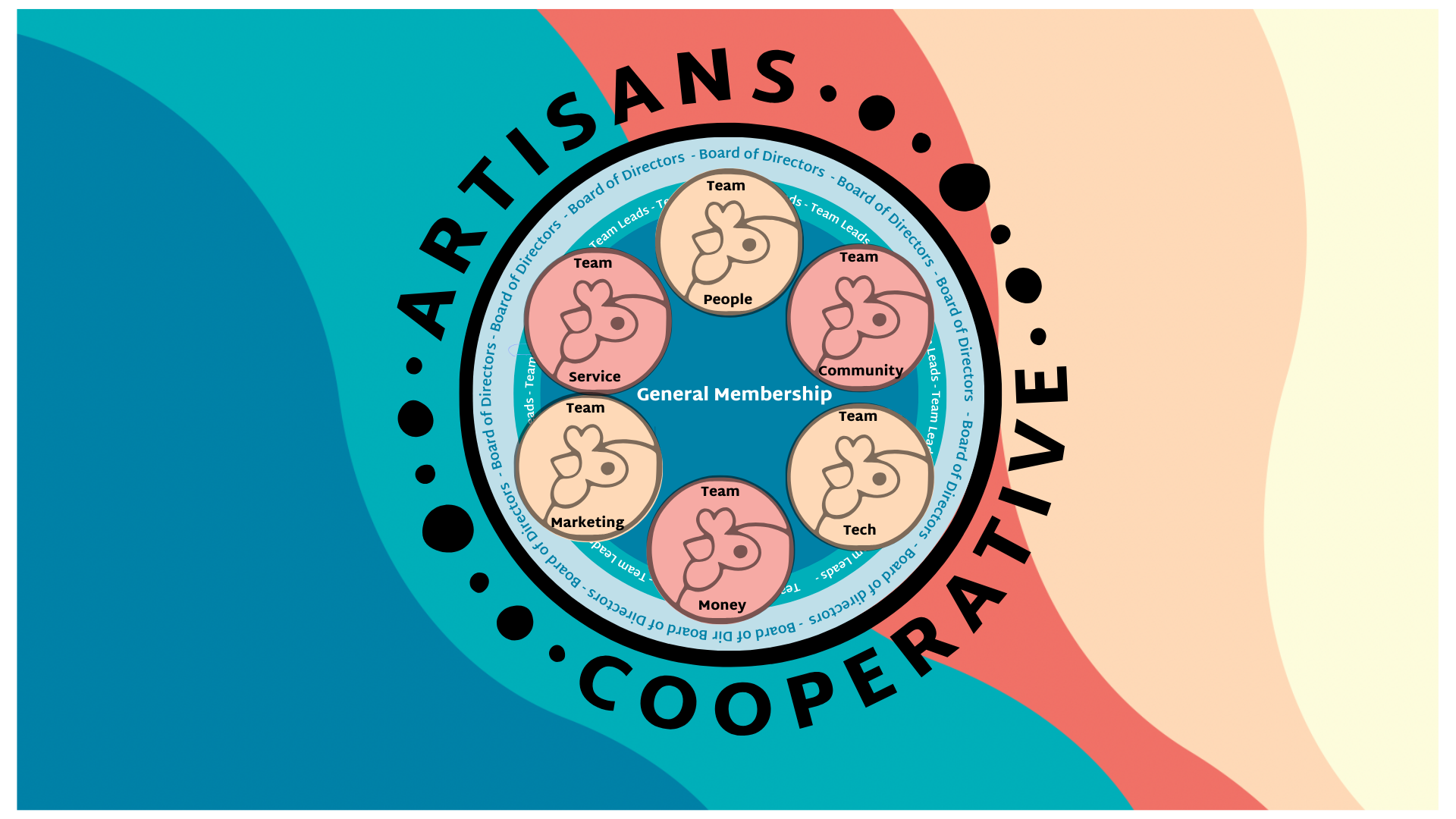
Teams autonomously develop their workflows, roles and activities through our group agreement, in which members come to consensus on potential decisions. Teams utilize a co-leadership system to cooperatively bottom line important tasks and communications with others teams, the board and external cooperators. They use a Team Leads circle to develop cross-team policies and proposals through consensus building.
Each year the membership votes on it’s board of directors from nominated members. The Board of Directors reviews proposals from team leads by request, contributing their concerns and feedback to the development of consensus amongst all leaders. Decisions identified as the sole responsibility of the board, by Team Leads, are made in cooperation with advisors and legal consultations amongst Directors with consideration for previous feedback from Leads and Members..
Members Economic Participation
Ownership & Equity Sharing
Our unique Ownership Model brings everyone to the table as stakeholders in balance. To join the co-op as a member, there is a brief application and a one-time investment in the co-op that purchases one share of ownership, and can be completed over time: a membership buy-in.Cash payments, and cash payment plans, are available to members who prefer to complete their buy-in monetarily:
Artisan Participation Buy In: 900 activity points (or an additional $900)
Supporter Participation Buy In: 90 activity points (or an additional $90)
- Our innovative Points & Tiers Policy ensures that both member buy-ins and financial rewards will be distributed equitably based on all kinds of co-op contributions (not just cash). This policy incentivizes member engagement, facilitates our Handmade Policy, and lowers the barriers to cooperative business ownership for all.
- The Points & Tiers Policy also ensures that even though a member can only select one member class (Artisan or Supporter, for example), all members will accrue benefits and financial dividends of all classes. For example Artisans will earn points on all purchases made on the site, just like consumer co-ops.
Revenue Model
To support our creative livelihoods and the handmade industry, we offer a simple, transparent commission system and at-cost payment processing for orders: no listing fee, no subscriptions. We provide members the ability to choose their own commissions, and update them upon request:
Artisan Sellers: 8% sales commission + 3.49% + $0.49 payment processing fee
Supporter Sellers: 9.5% sales commission + 3.49% + $0.49 payment processing fee
Sellers: 12% sales commission + 3.49% + $0.49 payment processing fee
General Sellers, who are not members of the cooperative, make the highest investment into our revenue and are issued no share of the marketplace’s profits from commissions. While donations to Artisans Cooperative are accepted, we are not a tax-exempt organization and donations are subject to state and local taxes as applicable.
Autonomy & Independence
Operations & Teamwork
Activities are the contributions members make to the co-op to make it successful for all. For us, patronage includes things such as buying and selling, handmade verifying, grassroots promotions, operational activities and projects, and leadership roles.
This system unites all contributions and all members into one successful co-op rather than dividing members by “class”.
Members self organize into Teams, autonomously operating sectors of our business through consensus amongst team members, across teams, and along the full range of governing stakeholders. Gaps in operational capacities that can’t be filled with member activities are addressed through contracts with other cooperative enterprises, furthering our principle of Cooperation Amongst Cooperatives.
Artisans Cooperative Group Agreement
Together we make the following commitments to ourselves and each other:
- I will enable access, prevent domination, and allow even the quietest voice and diverse communication style to be heard. I will share speaking time so that everyone has a chance to contribute to the conversation. When someone else is talking, I will wait a beat to make sure they are done talking before stepping in. If the conversation is lively, I will initiate using “stack” (a method by which people join a queue to speak in order by typing “stack” in the chat feature of audio-visual meetings) or a similar method to ensure everyone has a chance to speak. I will actively ask for opinions from others, especially those who haven’t spoken. We are organized as a sociocracy, and the sociocratic meeting method is a good way to enable everyone’s voice to be heard.
- I will express my needs to the group as they arise. (One method to ensure this is to have a round-robin “check-in” at the beginning of a meeting to give each participant a platform to express personal aspects of their presence at the meeting.)
- I will be open to sharing my thoughts and giving feedback with a vision of achieving our shared goals. I will make a special effort to give feedback that focuses on the work and not the person, and that is specific, actionable, and focused on helping my colleagues improve. I will be respectful when challenging others’ ideas, without personal attacks. (Both positive and critical feedback can incorporate affirmations and reinforcement, such as “I like xyz but have you also considered…” “Yes AND…”)
- I will be open to receiving feedback and will take it as an opportunity for growth and development. I am open to my ideas being challenged respectfully. I understand that the goal of feedback is to hone and improve our ideas and work processes, to be the best possible team and achieve the best possible product.
- I will embrace the sociocratic idea of managing the work and not the person. I will trust my colleagues to do their own scopes of work while I do mine, and will trust the process of group accountability.
- I will be curious and open to diverse possibilities. I will actively listen with an intent to fully understand, before thinking about how to respond. I will reflect on what others said and seek clarification if necessary.
- I will assume positive intent, giving others the benefit of the doubt. We all make mistakes and we will approach conflict with our colleagues with curiosity and a willingness to learn situational details to understand the why behind the problem. We do not place blame, we investigate and problem solve.
- I will respect confidentiality, keeping private (not sharing with others) things that were intended to remain private (such as personal stories), keeping spaces safe to share our ideas.
- I will use inclusive language and try to avoid language that excludes or offends.
- I will use plain language and try to avoid field-specific specialty terms, jargon, or acronyms.
- I will acknowledge when I am building on someone else’s ideas.
- I will recognize the effects of privilege, unconscious bias, and discrimination related to race, class, gender, sexual orientation, ability, neurodiversity, and other differences. I will honor the different experiences that we all bring to the space, being mindful of my own biases and working to overcome them by seeking feedback and perspectives that differ from my own.
- I will endeavor to act to benefit my fellow members in Artisans Cooperative, and always in the best interest of the Coop itself. I will keep the 7 principles of cooperativism and the values of the Coop–inclusion, member-owned, free and fair marketplace, and authentically handmade–as the focus of my work. Sometimes pragmatic business decisions must be made, but they should be made through the lens of the Coop’s values.
- I will be self-accountable to the group, with regard to quality of work, meeting deadlines, and contributing ideas. If falling behind, I will communicate why and reschedule if I might miss a deadline. I will aim to be present in real-time work, respecting everyone else’s time.
- For the good of our co-op and our members, when I notice a problem in an existing project for a team I am on, I will take ownership to fix the problem myself or the initiative to work with someone else to fix it if I don’t know how. If I noticed food were on the floor, I wouldn’t walk by and wait for someone else to clean it up. (For new projects I will consult with Team Leaders or submit a Member Proposal before beginning work.)
- I will share knowledge, document processes, save my work products to the shared drive with shared permissions, and endeavor to make my work visible and transferrable to the next person someday.
- I will be proactive in addressing conflicts or problems that arise. If I am uncomfortable doing this myself directly, or if the problem feels bigger than one I can address on my own, I will seek out the help of others, including a Team Leader. I understand that conflicts are a natural part of any collaborative process and addressing conflicts in a proactive and constructive manner is essential for maintaining a strong and effective team. I will approach conflicts with an open mind, seeking to understand the perspectives and concerns of all parties involved. I will strive to communicate clearly and respectfully, avoiding personal attacks and focusing on finding a mutually acceptable solution.
Business Ownership & Supportive Service
While Artisans Cooperative and profits from the marketplace it operates belongs to it’s collective of members, each seller retains their autonomy over the operations of their creative business, hobby, or practices.
Sellers list & ship their own products, handle their own customer service and set their own promotions. They can run multiple shops with separate branding and use their digital storefront on our marketplace as the ecommerce component of their own websites.
Our Service team supports business owners in making the best use of the marketplace and their membership without imposing on their autonomous decision making. Our Marketing team provides handmade verified members with curated promotions and paid advertisement through our branded public marketing channels. Our People team offers one-on-one sessions with a member, to get tailored support from a real live person, on your schedule.
Education, Training & Information
Our members, advisors and cooperative partners share skills and resources on building and supporting creative livelihood for any person, micro-business, or collective that produces handmade goods for sale. We self select into roles and activities based on interests, capacity, and a willingness to deploy or develop skill sets within or across operational teams.
Artisans Cooperative is the first “verified” handmade marketplace: welcoming and accessible for all mediums, disciplines, and niches. Our marketplace features authentic, original works produced with the care, dexterity, and judgment of an artisan who, at some point in the process, could ruin the work. We educate both members and the public on this definition of handmade works, on the value of handmade goods as compared to mass productions, and on the impact of creative labor and livelihood on socio-economic realities across time and geography.
Cooperation amongst Cooperatives
Artisans does not currently employ staff and is completely operated through the patronage activities of it’s membership. Work that cannot be fulfilled by operational teams based on member availability and capacity is shared with Cooperatives specializing in that work under the direction of team members and leadership through participatory contracts, cross-membership agreements, technical assistance contracts and consultation.
Concern for Community
We’re committed to providing the handmade community, sellers and shoppers alike, a more trustworthy marketplace of authentically handmade goods that offers simple, transparent fees and higher quality service. Our marketplace is a big tent, welcoming and accessible for genuine artists of all kinds, all around the world, making art that they could ruin with their own hands.
Artisans has some additional values that are critical to how we evaluate potential decisions and shape our shared business. Quotes come from Ours to Hack and to Own (2):
Seller Bill of Rights
- Inclusion and input. The users of the platform should be involved with the design, from the very beginning.
- Earnings maximization for workers. Platforms on which workers can organize their own small enterprises (like artisan businesses) tend to generate higher levels of income for platform workers.
- Stability and predictability. Innovations in platform design can have a direct impact on people’s livelihoods. Minimize such volatility and give workers sufficient time or compensation to adjust to forthcoming changes.
- Transparency. Practice transparency on two levels: the platform algorithm itself (so workers understand how to increase their earnings) and archived data (so users of the platform understand how their personal data is being used).
- Portability of products and reputations. People working on platforms should be able to own the products of their work, including their product listings, customer relationships, and reviews / reputation histories.
- Upskilling. Connect people with pathways for learning new skills and advancement opportunities.
- Social connectedness. Enable and foster communities for today’s workers to exchange tips, connect, and build relationships with each other.
- Feedback mechanisms. Establish “ombudsman” services, equivalent of customer support for all users and workers.
- Convenient solidarity. Design needs to be convenient, focused on attracting people, and fulfilling its value proposition.
- Stewardship. Engage members so they become active stewards of the co-op, not passive participants.
- Removing economic barriers and enabling distributed ownership. One way is to make it relatively simple for a user to “multi-home”: be a provider on multiple platforms.
- Beyond “luxury cooperativism.” “The point, as cooperative advocates have come to realize, is not to create maximally pure alternatives that help a few escape an alienating system, it’s to take seriously a long-term project of actually transforming what counts as business as usual – in the direction of equity, democracy, solidarity, and sustainability.”
Citations & Resources
(1) For All the People: Uncovering the Hidden History of Cooperation, Cooperative Movements, and Communalism. John Curl. 2012.
(2) Ours to Hack and to Own: The Rise of Platform Cooperativism, A New Vision for the Future of Work, and a Fairer Internet. Nathan Schneider and Trebor Scholz, editors. 2017.
(3) Kwakyewah, C. (2016). “Rethinking the Role of Cooperatives in African Development.” Inquiries Journal, 8(06). Retrieved from http://www.inquiriesjournal.com/a?id=1419
- Cooperative Principles: Alberta Community & Co-operative Association
- Curl, John. For All the People: Uncovering the Hidden History of Cooperation, Cooperative Movements, and Communalism in America. PM Press, 2009.
- International Cooperative Alliance
- National Cooperative Business Association / CLUSA International
- Rochedale Pioneers (Video Link)
- The United Nations International Day of Cooperation
- The University of Wisconsin’s Center for Cooperatives
About Artisans Cooperative
We are growing an online handmade marketplace for an inclusive network of creatives: a co-op alternative to Etsy. Shop the marketplace!